Showing posts with label Astronomy. Show all posts

2017/07/08

Hidden Galaxy IC 342


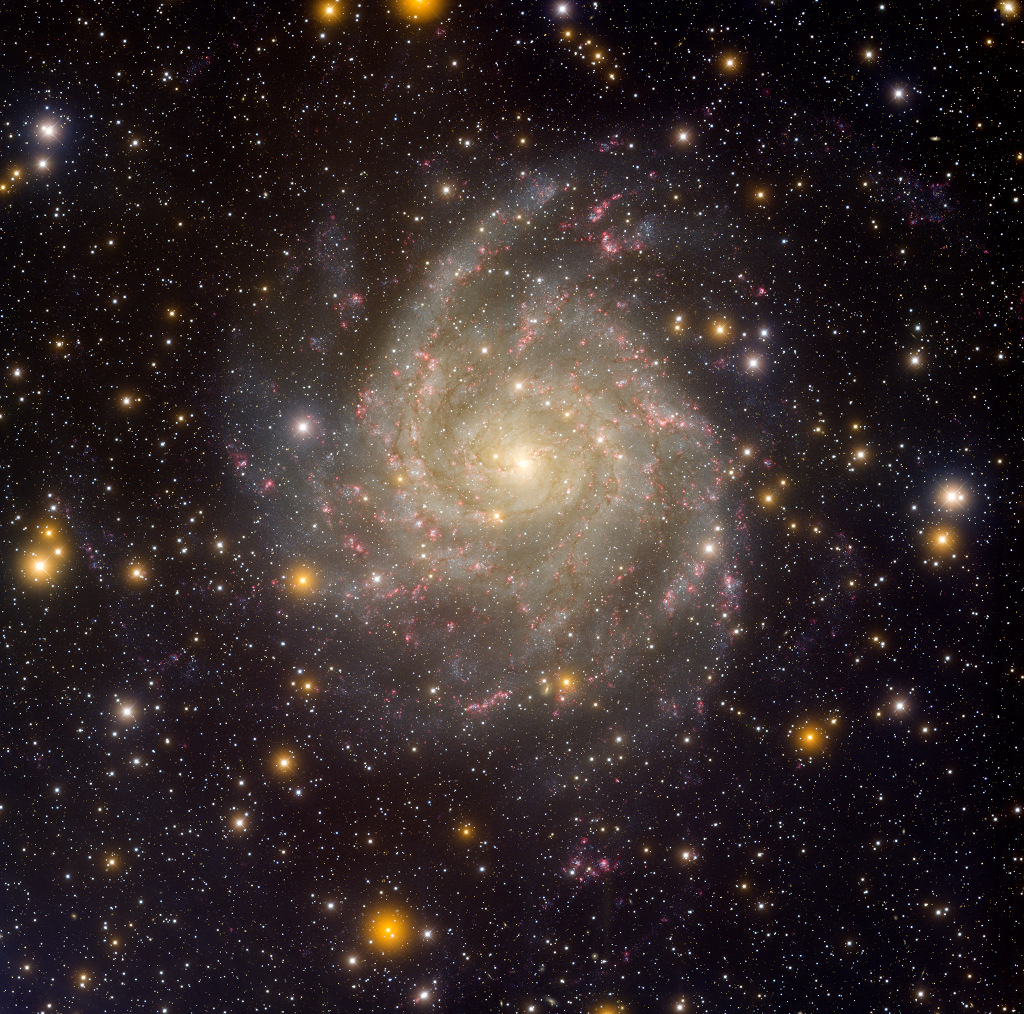
Similar in size to large, bright spiral galaxies in our neighborhood, IC 342 is a mere 10 million light-years distant in the long-necked, northern constellation Camelopardalis. A sprawling island universe, IC 342 would otherwise be a prominent galaxy in our night sky, but it is hidden from clear view and only glimpsed through the veil of stars, gas and dust clouds along the plane of our own Milky Way galaxy. Even though IC 342's light is dimmed by intervening cosmic clouds, this sharp telescopic image traces the galaxy's own obscuring dust, blue star clusters, and glowing pink star forming regions along spiral arms that wind far from the galaxy's core. IC 342 may have undergone a recent burst of star formation activity and is close enough to have gravitationally influenced the evolution of the local group of galaxies and the Milky Way.

via NASA https://go.nasa.gov/2sQAWTs
2017/07/07

A View Toward M106


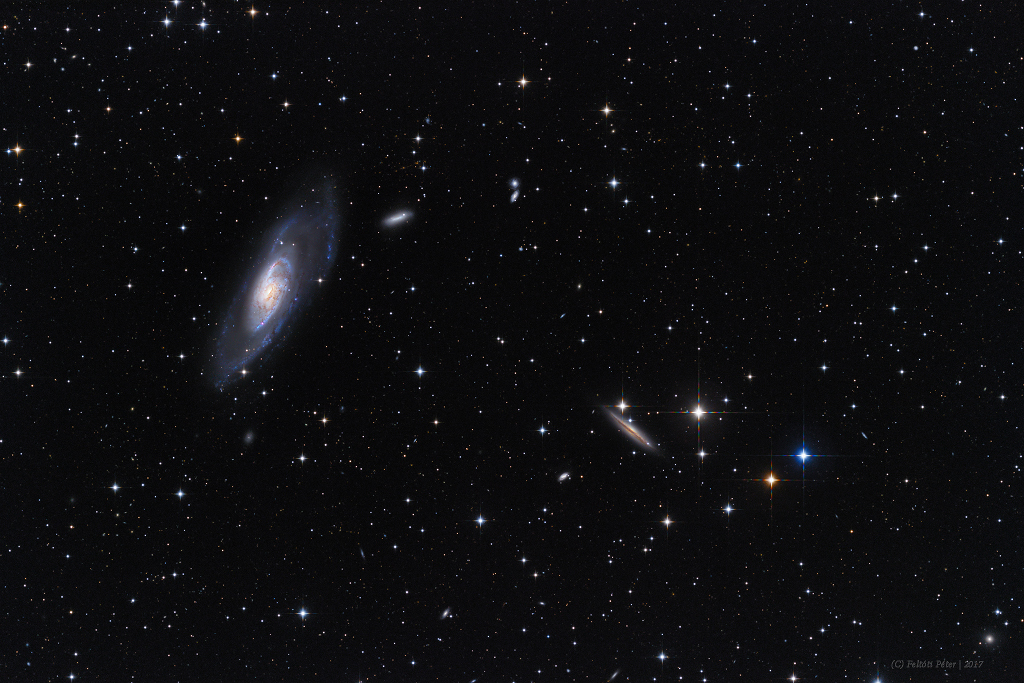
Big, bright, beautiful spiral, Messier 106 dominates this cosmic vista. The two degree wide telescopic field of view looks toward the well-trained constellation Canes Venatici, near the handle of the Big Dipper. Also known as NGC 4258, M106 is about 80,000 light-years across and 23.5 million light-years away, the largest member of the Canes II galaxy group. For a far away galaxy, the distance to M106 is well-known in part because it can be directly measured by tracking this galaxy's remarkable maser, or microwave laser emission. Very rare but naturally occuring, the maser emission is produced by water molecules in molecular clouds orbiting its active galactic nucleus. Another prominent spiral galaxy on the scene, viewed nearly edge-on, is NGC 4217 below and right of M106. The distance to NGC 4217 is much less well-known, estimated to be about 60 million light-years.

via NASA https://go.nasa.gov/2sSTbTn

2017/07/05

Aphelion Sunrise


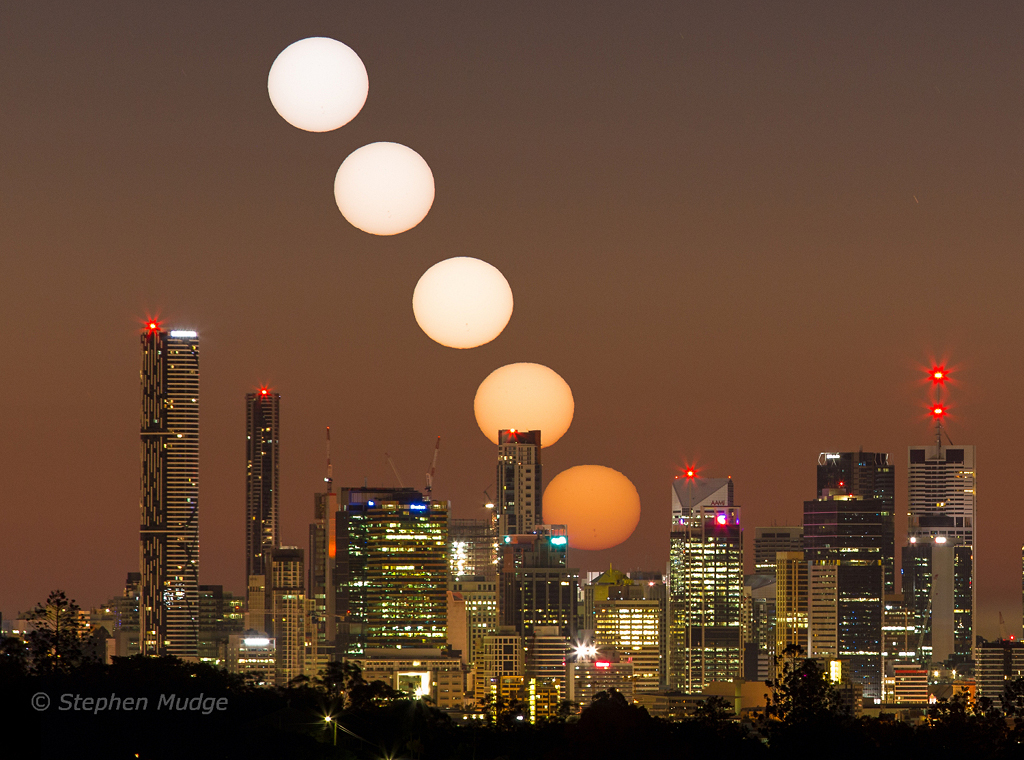
On July 3rd, planet Earth reached aphelion, the farthest point in its elliptical orbit around the Sun. Each year, this day of the most distant Sun happens to occur during winter in the southern hemisphere. That's where this aphelion sunrise from 2015 was captured in a time series composite against the skyline of Brisbane, Australia. Of course, seasons for our fair planet are not determined by distance to the Sun, but by the tilt of Earth's rotational axis with respect to the ecliptic, the plane of its orbit. Fondly known as the obliquity of the ecliptic, the angle of the tilt is about 23.4 degrees from perpendicular to the orbital plane. So the most distant sunrise occurs during northern summer, when the planet's north pole is tilted toward the Sun and the north enjoys longer, warmer days.

via NASA go.nasa.gov/2tfBeSA

2017/07/03

The Summer Triangle over the Great Wall


Have you ever seen the Summer Triangle? The bright stars Vega, Deneb, and Altair form a large triangle on the sky that can be seen rising in the northern spring during the morning, and rising in the northern fall during the evening. During summer months, the triangle can be found nearly overhead near midnight as three of the brightest stars on the sky. Featured here, along with the arch of the central band of our Milky Way Galaxy, the Summer Triangle asterism was captured this spring over the Great Wall of China. This part of the Great Wall, a World Culture Heritage Site, was built during the 6th century on the Yan Mountains. At the summit is Wangjinglou Tower from which, on a clear night, the lights of Beijing are visible in the distance.

via NASA https://go.nasa.gov/2ufQyNg

2017/07/02

Mountains of Dust in the Carina Nebula


It's stars versus dust in the Carina Nebula and the stars are winning. More precisely, the energetic light and winds from massive newly formed stars are evaporating and dispersing the dusty stellar nurseries in which they formed. Located in the Carina Nebula and known informally as Mystic Mountain, these pillar's appearance is dominated by the dark dust even though it is composed mostly of clear hydrogen gas. Dust pillars such as these are actually much thinner than air and only appear as mountains due to relatively small amounts of opaque interstellar dust. About 7,500 light-years distant, the featured image was taken with the Hubble Space Telescope and highlights an interior region of Carina which spans about three light years. Within a few million years, the stars will likely win out completely and the entire dust mountain will evaporate.

via NASA https://go.nasa.gov/2tDwV4A

2017/07/01

3D Lava Falls of Mars


Get out your red/cyan glasses and gaze across lava falls of Mars. The stereo anaglyph was created by combining two images recorded by the HiRISE camera onboard Mars Reconnaissance Orbiter. The multi-level falls were created as flowing lava breached sections of the northern rim of a 30-kilometer diameter martian crater, located in the western part of the Red Planet's volcanic Tharsis region. As the molten lava cascaded down the crater wall and terraces to reach the crater floor it left the distinctly rough, fan-shaped flows on the steeper slopes. North is up and the breathtaking 3D view is 5 kilometers wide.

via NASA https://go.nasa.gov/2twj3IN

2017/06/30

NGC 7814: The Little Sombrero in Pegasus


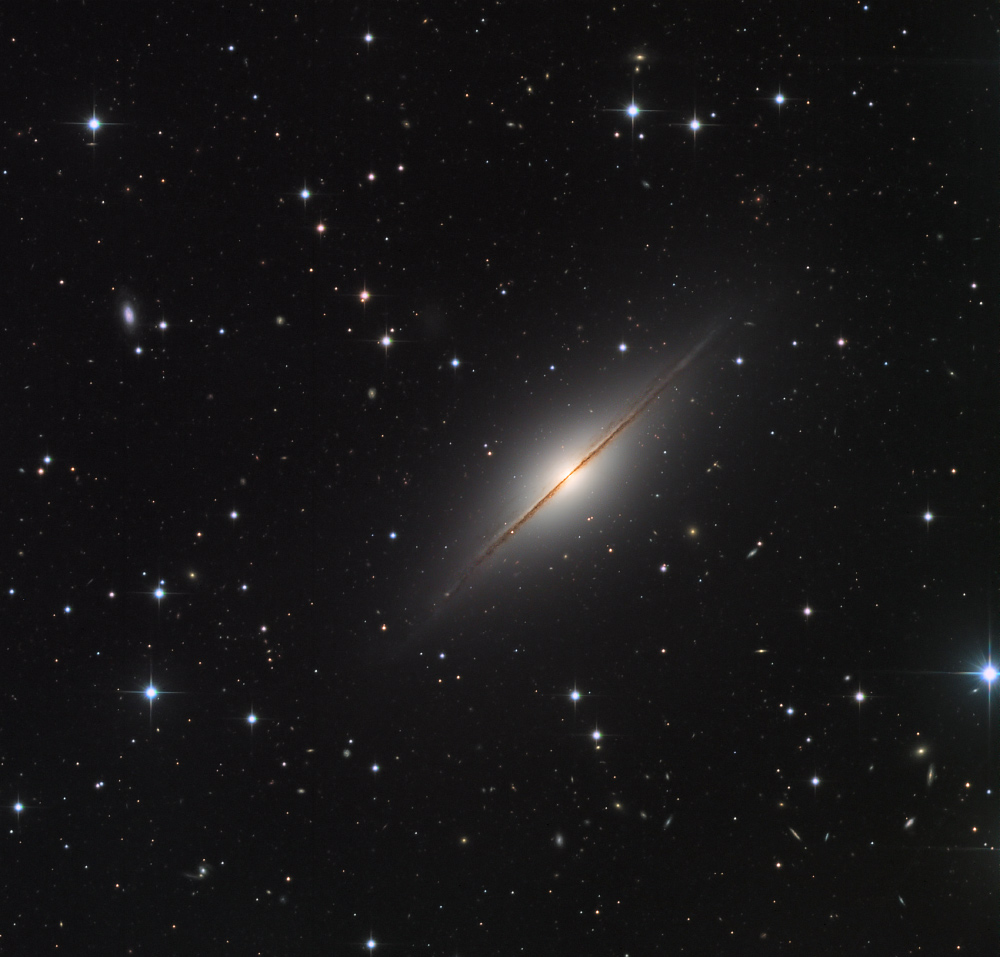
Point your telescope toward the high flying constellation Pegasus and you can find this expanse of Milky Way stars and distant galaxies. Dominated by NGC 7814, the pretty field of view would almost be covered by a full moon. NGC 7814 is sometimes called the Little Sombrero for its resemblance to the brighter more famous M104, the Sombrero Galaxy. Both Sombrero and Little Sombrero are spiral galaxies seen edge-on, and both have extensive halos and central bulges cut by a thin disk with thinner dust lanes in silhouette. In fact, NGC 7814 is some 40 million light-years away and an estimated 60,000 light-years across. That actually makes the Little Sombrero about the same physical size as its better known namesake, appearing smaller and fainter only because it is farther away. Very faint dwarf galaxies, potentially a satellites of NGC 7814, have been discovered in deep exposures of Little Sombrero. via NASA https://go.nasa.gov/2ssKYoB